Didier Drogba at the World Cup: How a Struggling Nation Found Its Symbol
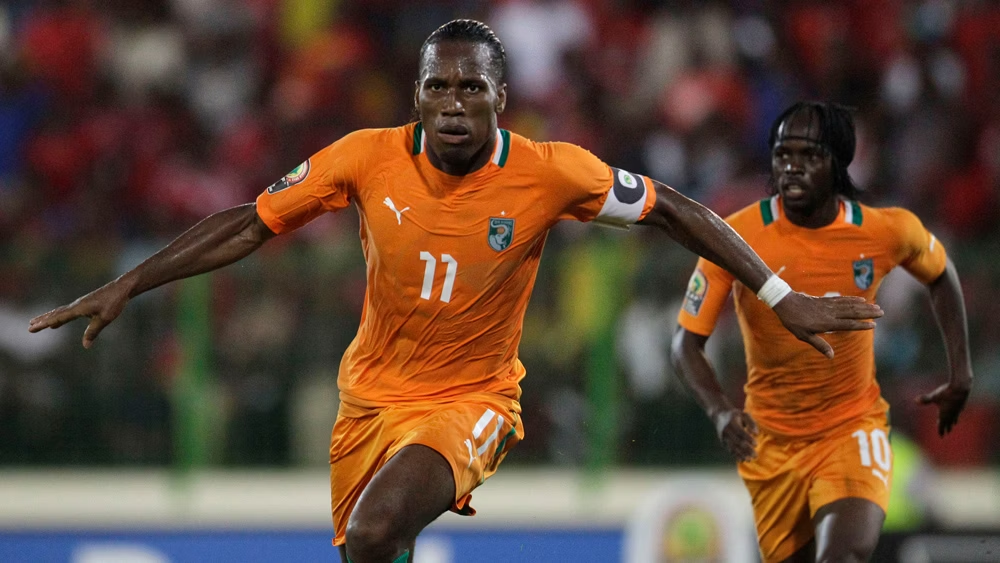
More Than Football
To understand what Didier Drogba meant to Ivory Coast at the World Cup, you must first understand the context. Côte d'Ivoire had spent much of the early 2000s in the grip of a civil conflict that had divided the country along geographic and ethnic lines. Football — specifically, the national team — became one of the few things that could unite people across those divisions.
In 2005, after Ivory Coast qualified for their first World Cup, Drogba delivered a famous post-match speech, broadcast live, in which he pleaded for the country to lay down its weapons. Observers credit that moment with contributing to a ceasefire. A footballer's words, in the right moment, carrying the weight of a nation.
The World Cup Stage
Ivory Coast qualified for three consecutive World Cups: 2006, 2010, and 2014. Each time, they were drawn into what journalists dubbed the "Group of Death." In 2006, they faced Argentina, the Netherlands, and Serbia — some of the most talented sides in the tournament. They did not advance, but Drogba's performances announced a generation.
By 2010 in South Africa, Drogba was playing through a broken arm — shielded by a protective cast — after suffering the injury in a pre-tournament warm-up. That he played at all was testament to his commitment. He scored against Greece and drove Ivory Coast through the group stages, though they were ultimately eliminated.
2014: The Final Chapter
At Brazil 2014, a 36-year-old Drogba came off the bench to equalise against Greece in injury time, keeping Ivory Coast's qualification hopes alive. They went on to win that game. It was, in many ways, a microcosm of his entire career: the intervention at the critical moment, the weight of a nation on his shoulders, delivered.
The Rising Stars Who Followed
Drogba's legacy at the World Cup is not just in his goals but in what he made possible. Wilfried Zaha, Sébastien Haller, and a new generation of Ivorian players have grown up understanding that the World Cup is not beyond them. Nicolas Pépé, Franck Kessié — players who had Drogba as their reference point. The seed he planted continues to grow.